
Blue skies, wide open spaces and rolling fields of grass greeted participants of the three-day Canadian Forage and Grassland Association (CFGA) mentor tour, celebrating the International Year of Rangelands and Pastoralists. Mentors and industry participants climbed on a bus in Regina and wound their way south to visit demonstration sites across Saskatchewan and Alberta.
A wet spring meant many of the pastures were lush with vegetation, compared to the normal brown landscape typically observed in the semi-arid region; an observation which was repeated multiple times throughout the tour.
Day 1 – Swift Current
Mentors began in Swift Current with a visit to Cyle and Ericka Stewart’s ranch. Here participants hopped on board a hay wagon and toured fields the Stewarts have been actively practicing rotational grazing. Tom Harrison and Mindy Hockley-Anderson of the Saskatchewan Stock Growers Foundation joined the tour.
Cyle pointed out changes to the landscape and talked about how they’ve changed their practices on the 5,540-acre ranch where they run 200 cow-calf pairs and 40 replacement heifers.
As the mentors stood in thigh-high grass where cattle had bale grazed the previous winter, the results were obvious. Dark green swaths marked where each bale had left nutrients behind. Cyle said soil infiltration tests show a 10-minute difference between where bale grazing was done, versus the surrounding soil.
The Stewarts buy all their hay and use their range specifically for grazing which starts in May and continues until December using a combination of native and tame pastures. Investing in water pipeline and allowing cattle to water away from dugouts made big changes for them.
“We focused on what was at the end of the cow’s nose,” Cyle explained. “Increased health of plants increased animal health and conception rates; it started with the water.”
Over the past three years of focused rotational grazing the Stewarts have noted improved plant diversity, as well as more wildlife. They’re waiting on a data from a recent insect and bird count to confirm observations they’ve made in the field.
Day 2 - Val Marie
Day two of the tour had mentors visiting a ranch which is part of the South of the Divide Conservation Action Program (SODCAP). Rancher Pat Hayes talked about his operation and explained how he reseeded some of this pasture with native species.
The section is used for calving starting around mid-April and the cattle are removed from it by mid-May, essentially grazing the grass when it’s dormant. The pasture is then allowed to grow for use the following year and the cattle are moved onto sections with tame grass.
Solar pumps, water hoses and troughs supply water throughout the range from fenced off dugouts.
Improving the land had the benefits of improving the herd, increasing pollinators and insects and other species in the area.
During the afternoon, the tour stopped in Grasslands National Park where participants learned more about native plants and wildlife in the area. A hike through a section of badlands allowed them to see how diverse the vegetation is and learn how to identify common native species under the guidance of self-identified plant nerd and CFGA forage specialist, Mick Plemel. They also had an opportunity to learn and practice how to conduct a water infiltration test which shows how quickly water is absorbed by the soil under the guidance of CFGA forage technician Morgan Kitchen.
The day ended with a presentation by Carmen and Arlis Hanson, owners of a multi-generational ranch and outfitting business in the area.
Day 3 - Alberta
Day three of the tour started in Grassy Lake at Riverview Ranch where mentors toured the ranch with fifth generation rancher Tyler Torrie. He talked about his use of virtual fencing and how it allows them to manage their cattle and grazing using technology in the form of the Gallagher eShepherd.
In a region with steep slopes, coulees and tens of thousands of acres of unfenced pasture, the technology makes it possible for them to control cattle movement without the time, labour and cost of installing fences.
At lunch, mentors learned about water usage and water restoration in Alberta. Cows and Fish and Alberta Watershed were both on hand to talk about their programs and the benefits of protecting riparian areas.
The final stop of the tour was Antelope Creek Ranch where manager Neal Wilson discussed how agriculture, industry and nature can co-exist.
With careful grazing and a well-managed rotation, the ranch has improved its carrying capacity since it was established in 1986. Today, between 210 to 240 cow-calf pairs graze the property, almost double what the ranch could support in the beginning.
Additionally, native grasses are making a comeback. Neal walked the mentors through a field currently being grazed and showed them the variety of plant species available.
The three-day tour illustrated the value of managing both tame and native pastures to support healthy livestock and eco-diversity.
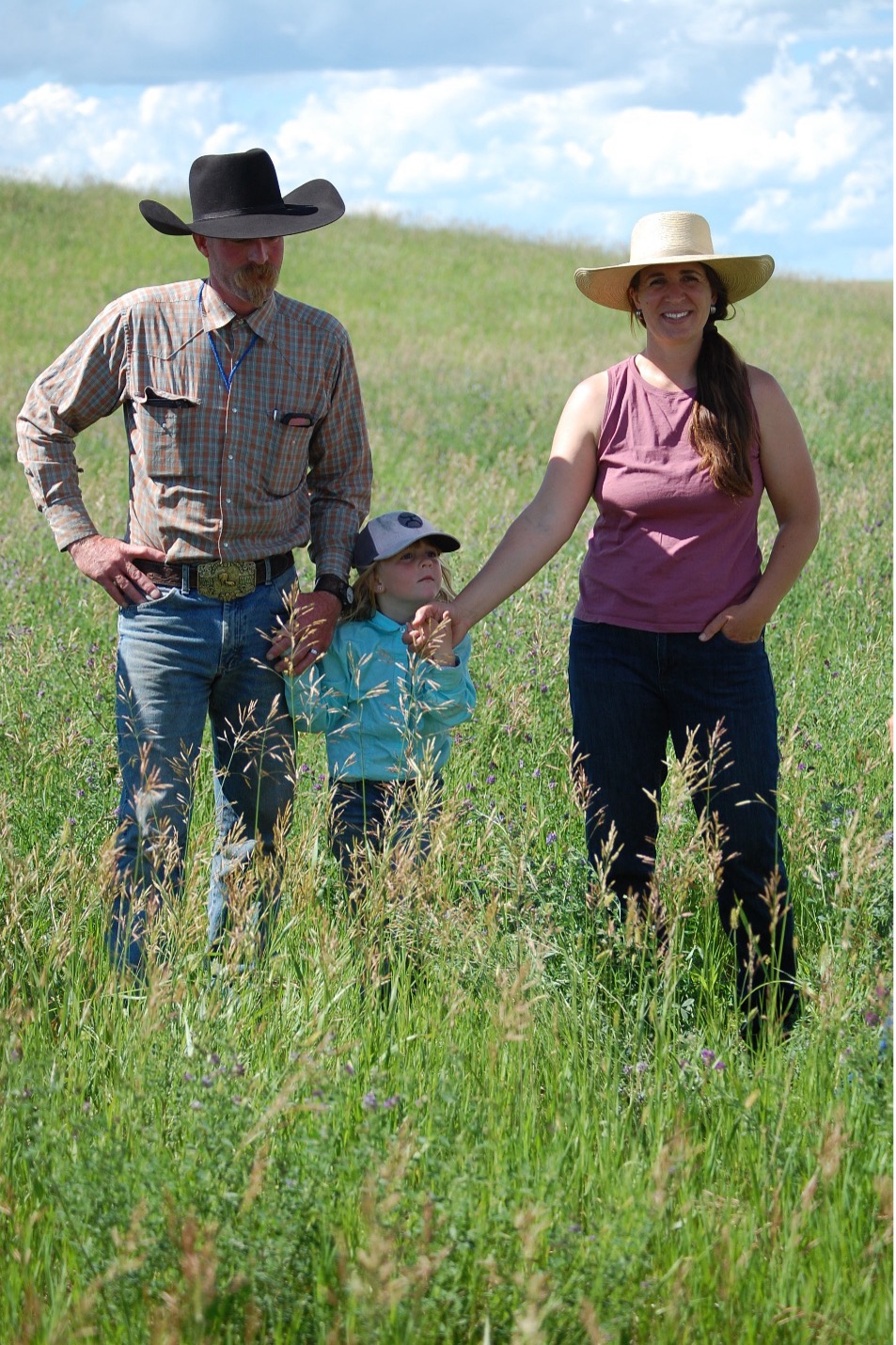
Cyle and Erika Stewart explain how bale grazing improved their pastures.
Wagner photo
Back to General

Leave a Comment