Site Background
About the Location
The Greener Pastures Ranching Bale Grazing and Advanced Grazing Systems (Greener Pastures) Demonstration Site is located in the Foothills Parkland subregion south of Highridge, Alberta.
The landscape is characterized by gently rolling hills and open prairie, with a few small creeks and wetlands and natural vegetation that includes grasses, shrubs, and scattered trees such as trembling aspen and balsam poplar. Soils in the region are predominantly dark, fertile chernozems, rich in organic matter.
The area typically receives around 400-500 mm annually. Average temperatures include a summer mean of 22°C and a winter mean of -15°C.
About the Farm
Greener Pastures Ranching Ltd. (est. 2000) is a first-generation farm owned by Steven Kenyon Steven’s interest in rotational grazing comes from a belief that regenerative practices will allow us to be sustainable for generations. The custom grazing operation runs roughly 1200 head of livestock and 100 sheep on 3000 acres of leased land.
Learning about Rotational Grazing
Steven learned about rotational grazing through private industry seminars, conferences and schools over the last 25 years.
The Rotational Grazing Objective
The goal of this demonstration project is to promote and educate about Advanced Grazing Systems (AGS) and to show how practices can help build soil. Steven also uses bale grazing as another tool to help build soil water-holding capacity and improve pasture health.
Steven noticed that some paddocks did not respond as readily to AGS and wanted to determine whether bale grazing and the addition legumes could be used to accelerate soil health improvements.
Why Did You Do This Project?
Steven chose to do this project as a few of his paddocks did not heal as fast as others with an AGS and needed additional help. Bale grazing and adding legumes can speed up the healing process. “We have learned that we lose many of our clovers, for example, due to extremely dry years. It is worthwhile to add more seed to increase diversity.”
History & Soil Tests
The demonstration site pasture is a single paddock in a larger AGS.
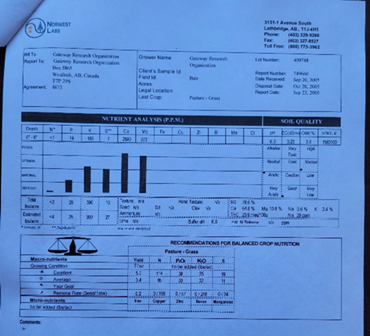
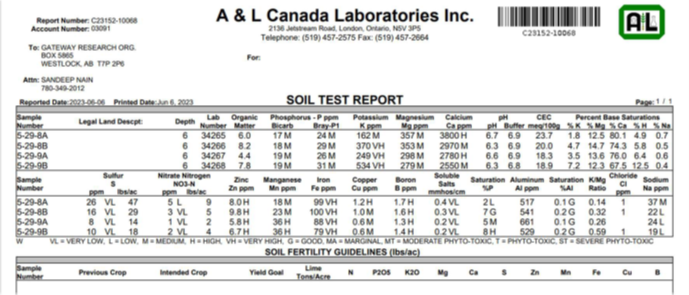
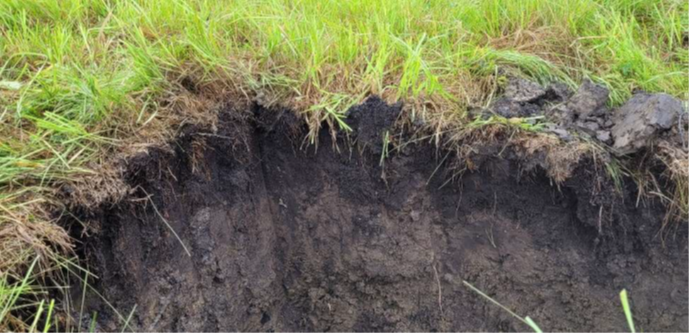
Soil tests and visual evidence indicate that Greener Pastures Ranching has significantly improved soil structure over a 17-year period. Initial soil tests conducted in 2005 established baseline conditions for two paddocks. Following this, one paddock was managed using bale grazing while the other was not. Both paddocks were retested in 2023.
Results show increases in soil organic matter in both paddocks, with greater gains observed in the bale-grazed area. The bale-grazed paddock measured 6.0% organic matter at 0–6 inches and 8.2% at 6–12 inches, compared to 4.4% and 7.8% respectively in the non-bale-grazed paddock. Average soil organic carbon increased to 6.6, and estimated topsoil depth reached approximately 10 inches. Soil pH also increased, indicating reduced acidity.
All soil tests were conducted by the Gateway Research Organization using standardized sampling procedures. Further, more extensive soil testing is planned.
2005 Soil Test
2023 Soil Test
Agronomic Details
The site is 560 acres with barb-wire perimeter fencing and single wire high tensile cross fences. Water is pumped from dugouts and the nearby creek. Water system installation occurred in 2009.
Project Overview
Livestock are rotated through a total of 25 paddocks every two days, resulting in approximately 2–2.5 grazing cycles per paddock over the grazing season. As water holding capacity improves the number of rotations possible has increased. Paddocks will receive roughly 50 days of rest between grazing events, with longer recovery periods during later rotations as forage growth slows. 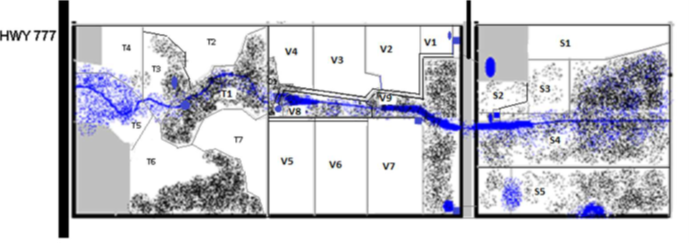
Short-term Project Goal
In the short term, this project aims to maintain livestock carrying capacity, even under drought conditions.
Long-term Project Goal
Greener Pastures’ primary goal is to grow soil; this is achieved using livestock to manage a perennial polyculture.
What’s Happening
Steven Kenyon continued to custom graze the project. The practice has improved soil resilience and maintained the forage required for annual species to thrive.
Additional Media
Funding for this project in part has been provided by Agriculture and Agri-Food Canada through the Agricultural Climate Solutions – On-Farm Climate Action Fund.