
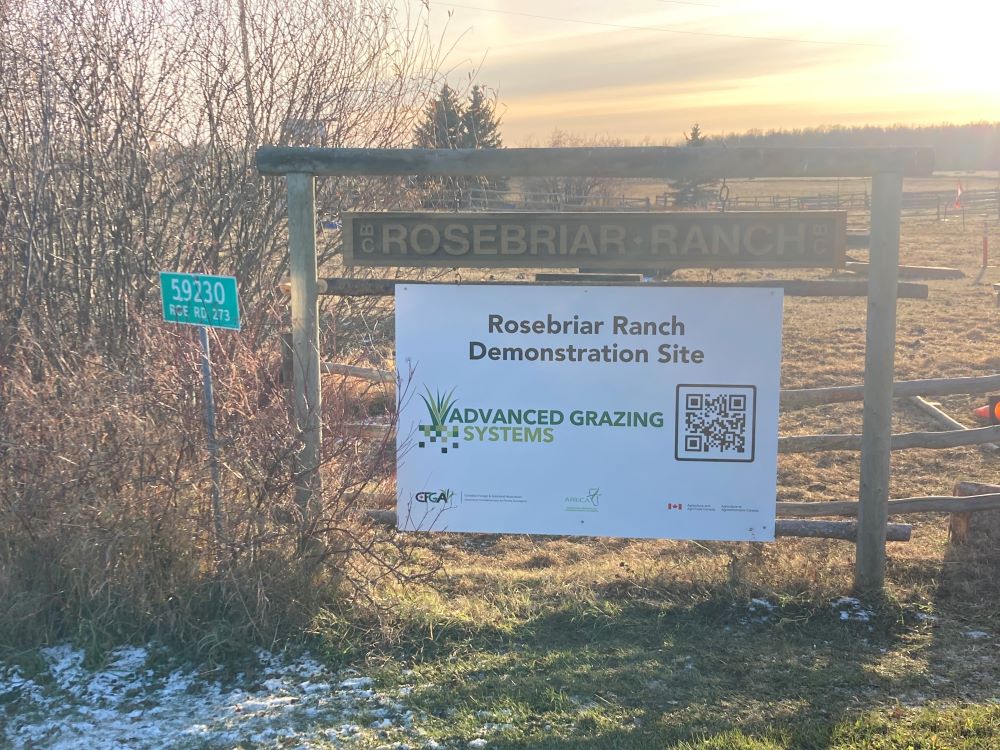
Site Background
About the Location
Rosebriar Ranch is located in the Aspen Parkland ecoregion, four miles west of Westlock, Saskatchewan.
This region experiences mean annual precipitation of roughly 450–500 mm, with summer temperatures averaging 16°C and winter temperatures -13°C.
Soils are predominantly Black Chernozems with poorly drained Gleysolic soils in low-lying areas. Native vegetation consists of a mosaic of trembling aspen groves, mixed shrubs, and fescue-dominated grasslands, interspersed with wetlands.
About the Farm
Rosebriar Ranch was established in the early 1950s. At the time the project was established, it was owned by third generation farmers Leane and Murray Buxton. Their farm has 40 cow-calf pairs as well as five horses.
Learning about Rotational Grazing
Murray Buxton is originally from New Zealand so rotational grazing is not a new concept. Together, the Buxton’s became interested in rotational grazing after completing a holistic management course in 1993; to some degree, they’ve been using the information they gained ever since.
Leane and Murray are interested in rotational grazing systems that optimize land management in ways that increase production without increasing input costs. They have been implementing rotational grazing methods that use animal impact and grazing to increase grass and forage production for approximately 30 years.
The Rotational Grazing Objective
The objective of rotational grazing at Rosebriar Ranch was to establish a sustainable pasture system that enhances soil biodiversity, optimizes the productivity of the land base, increases forage yield and livestock performance, and enables grazing without reliance on synthetic inputs such as fertilizer.
Agronomic Details
This four-acre site was seeded in the spring of 2017. Fencing infrastructure was in place, but 10 additional picket posts and one high tensile wire were added to the existing perimeter fence. Existing water troughs meet all livestock water needs required for this project.
Project Overview
The pasture had previously been cut for hay and grass growth was poor with low feed yield early in the season.
Livestock were held on pasture from the last week of October until the end of March. During this time, cattle had access to five bales of feed every four days with the electric fence being moved to allow access to new feed. They had continuous access to previously grazed feed which also allowed them to use the existing water system.
At the end of the season, plant growth and diversity as well as moisture retention were all excellent. The pasture was a noticeable deep green colour, in contrast to the yellow-green of surrounding pastures.
While using this system, Leanne and Murray observed more even manure distribution, improved grazing behavior (with animals eating what they needed rather than “binge eating”), and cleaner livestock with no issues related to lice or other parasites. They also saw significant reductions in bedding use, fuel consumption for feeding (just one tank from October to March), and labour (about 20 minutes every four days), along with no need to haul or spread manure.
If they had it to do again, Leanne and Murray would better define feed alleys with fencing to reduce issues with electric fence malfunction throughout the feeding season.
Due to unforeseen life circumstances in 2024, this grazing demonstration was discontinued. All livestock were sold in the fall of 2024 and spring of 2025.
Funding for this project in part has been provided by Agriculture and Agri-Food Canada through the Agricultural Climate Solutions – On-Farm Climate Action Fund.