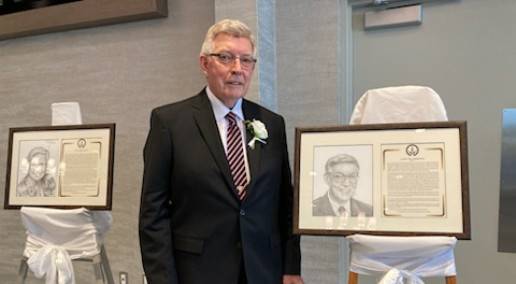
John Winchell is part of the Alltech global support team and focuses on helping producers create and store quality forage.
John presented at the Canadian Forage and Grassland Association’s (CFGA) 16th Annual Conference: Greener Horizons: Technological Innovations in Forage and Grassland Management. The conference took place Nov. 18 to 21 in Fredericton, New Brunswick, and was organized in partnership with the New Brunswick Soil and Crop Improvement Association (NBSCIA).
For producers, the goal of forage production should be quality and quantity and John is using nature’s visual cues, as well as technology, to help them achieve these goals.
“It’s easy to make a lot of feed; it’s not as easy to make good feed,” he said, adding it’s a balance to do both.
Digestibility is an important metric and the current standard of combined forages NDFD30 is 60 per cent. His perspective is digestibility of all forages should be in the 65 per cent range. He told attendees this change will keep animals healthier, increase components and increase profitability.
Focusing on fibre is a big part of the conversation.
“Everybody lumps forage into one basket, and all forages are not created equal,” he said. Cover crops, or what he calls winter forages, are gaining momentum across North America as they are very comparable to BMR corn silage and conventional corn silage in terms of NDFD30.
The key to creating quality forage, according to John, is to work with the weather. Each crop has an individual season and each farm has traditional weather patterns. He said producers want to find the best weather data for their region based on the crops they produce, such as corn heat units by location or traditional weather patterns from April 1 to June 1 to make haylage better.
“Harvest timing is critical and the key to your success,” he explained. “You want to be proactive versus reactive.”
It’s one thing to know growing degree days helps, but he said looking at the world around us can provide a more accessible story. He pointed to the spring phenology of daffodils and dandelions.
“When you look at the dandelion that’s not gone to seed, but it’s soft and supple in that white soft fuzz, [and] if you look at the degree days of grass, they match exactly,” he explained. “I’m using visual triggers to help farms harvest when they should.”
He said tracking degree days is tedious while looking at nature is easy. Looking at the lilacs can help you know when it’s time to make winter forage.
Other tips he provided is to get into the fields and look at the stems and preharvest samples about a week before harvest. He also talked about different types of technology and how they can be used to support quality harvests.
Making quality forage, and maximizing the quantity, is an art and a science. It requires keen observations and adoption of new technology.
2025 conference recordings
Would you like to hear all of this presentation?
The recordings are available for free to those who registered for the 2025 conference. Online access to recordings of all the conference sessions is also available for purchase.
For more information, email [email protected]
Back to General
Leave a Comment